
For many families, writing is one of the most confusing parts of Selective preparation to assess. A child may have strong ideas but fail to address the task, use impressive vocabulary without building a clear structure, or simply rush through the response without showing their real ability. A low writing score does not always mean the child cannot write. More often, it points to a specific problem that can be identified and improved.
Before arranging more classes or asking the child to memorise more model essays, parents should first understand what is actually holding the score back.

1. Why Do Some Students Receive Low Writing Scores?
Attitude and effort
For some students, low writing scores are clearly linked to attitude and effort. Parents can often recognise this without too much difficulty.
For example, a student may finish every writing task in just ten or fifteen minutes, or submit only one short paragraph of around 100 to 200 words each time.
In many cases, this attitude is not limited to writing. If parents look more closely, they may notice similar patterns across other subjects as well.
The CTedu Trial Test platform can provide useful performance data. However, when the underlying issue is attitude, parents ultimately need to address it directly with the child.
Writing off topic or only partly addressing the task
Parents who have reviewed Selective School Entry Test writing prompts from recent years may agree with an observation made by an experienced writing teacher: it is actually quite difficult to go completely off topic in a Selective writing task.
Current Cambridge-style Selective writing prompts are usually quite specific. They normally identify the text type and topic and also include several detailed requirements. Even if a student simply follows the instructions in a straightforward way, the response should still remain relevant to the task.
However, a noticeable number of students still write off topic or only partly address the prompt. Based on our analysis, there are usually two main reasons.
The first is again attitude. Some students treat the writing task too casually. Instead of reading the whole prompt carefully, they notice one word or one sentence and immediately begin writing whatever comes to mind.
The second reason may be the influence of some writing programs that place too much emphasis on descriptive detail, sophisticated vocabulary and memorised techniques, while giving insufficient attention to analysing the prompt.
This is similar to trying to master advanced martial arts techniques before learning the basic movements. Without strong foundations, complicated techniques can easily create more problems than they solve.
2. Introduction to the CTedu Writing Module
The CTedu writing module is an optional addition to the Trial Test platform.
It is powered by a recent large language model and has been designed around the Cambridge-style writing tasks used in the Selective School Entry Test. The marking approach has been repeatedly reviewed and refined by several experienced writing teachers.
It is designed to provide detailed, consistent and practical feedback that goes beyond a simple score.
The writing task is optional
Before students complete the three main Trial Test subjects, the writing task will appear as Pending.
Once the three subjects are complete, students may choose to complete the writing task or skip it and continue to the next Trial Test.
CTedu uses an additional-score writing model
In addition to providing a separate writing score, CTedu estimates how much the writing performance would adjust the student’s overall Trial Test score.
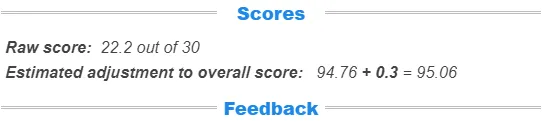
For example, if a student receives a score of 94.76 across the three main subjects and the writing adjustment is +0.30, the adjusted total becomes:
94.76 + 0.30 = 95.06
This indicates that the writing performance made a small positive contribution to the student’s total result.
Writing scores tend to cluster around the middle
High and very low writing scores are both relatively uncommon.
Based on our preliminary data, the current average writing score for CTedu students is approximately 18 to 20 marks.
3. Why Does CTedu Use an Add-on Writing Module?
Writing results can be less reliable in a Trial Test environment
All Trial Test platforms face the same issue: many students do not make a serious attempt at the writing task under normal Trial Test conditions.
For example, a student may write carelessly, reproduce a memorised model response or use AI-generated content.
If writing scores were included directly in the main total, these irregular responses could significantly reduce the accuracy of the rankings.
The adjustment value shows the real effect of writing more clearly
The writing adjustment allows parents to see whether a student’s writing is likely to improve, reduce or have little effect on the overall result.
This provides a more practical answer to the question many parents are really asking: Is writing helping my child, or is it holding the total score back?
Writing does not always need to be completed in every Trial Test
Once a student’s writing has reached a reasonable middle level, rapid short-term improvement may be limited.
In some cases, placing more preparation time into the other three sections may produce a greater overall benefit.
For this reason, CTedu does not require students to complete writing in every Trial Test. Families can schedule writing practice according to the student’s individual needs.
4. Will Writing Hold Back a High-Scoring Student?
Many parents ask whether students who perform very strongly across the three main subjects are more likely to have their total result reduced by writing.
Our data does not support this concern.
Based on CTedu’s broader statistical analysis, students scoring above 100 across the three main subjects will generally not be significantly held back by writing if they achieve approximately 21 to 23 marks or above.
Students and parents should pay particular attention to the writing adjustment shown after each Trial Test.
A positive adjustment indicates that writing has supported the overall score. Even an adjustment of negative one or two marks may often be offset by a strong performance across the other three subjects.
5. What Should Students Do If Their Main Scores Are Strong but Writing Is Holding Them Back?
The most effective approach is to solve the larger problems first before focusing on smaller details.
Start with the prompt
The most important step is to read and follow the task carefully.
A response that does not address the prompt can lose a substantial proportion of the available marks, even if the language itself is strong.
Before writing, students should identify:
- the required text type
- the main topic
- the intended audience
- the purpose of the response
- every specific instruction included in the prompt
Improve structure and content coverage
Once the student understands the prompt, the next priority is the overall structure of the response.
Marks may be lost when:
- the structure is unclear
- important ideas are missing
- the response does not develop its main points
- paragraphs are poorly organised
- the conclusion does not complete the task effectively
The Feedback section in CTedu provides detailed suggestions for improvement. Students and parents should read these comments carefully and identify the structural issues that appear repeatedly.
Refine the details gradually
When task relevance and overall structure are secure, a student is usually close to an average writing standard.
Further improvement can then come from refining smaller details, including:
- paragraph transitions
- sentence construction
- clarity and variety of expression
- vocabulary choice
- supporting detail
- punctuation and grammar
Students should work through the CTedu Feedback step by step rather than trying to improve every aspect of writing at once.
Final Thoughts
The most important principle is simple:
First make sure the response answers the task. Then improve how well it is written.